What Affects the Cost of Relocating a Pet to Indonesia
The cost of relocating a pet to Indonesia depends mostly on five things: where your pet flies from, the size of the travel crate, how your pet flies (cargo or, where allowed, a VIP or hand-carry option), what the Jakarta arrival and quarantine involve, and whether your pet continues on to Bali or another island. Two pets on the same date can receive very different quotes because each of these factors is calculated for that specific route and that specific animal.
This guide explains what drives a relocation quote for dogs and cats moving into Indonesia, what you can do to keep it under control, and what information we need to give you an accurate figure. It is written for owners moving from abroad, whether that is Australia, the United States, Europe or elsewhere in Asia. For the full process step by step, start with our pet relocation to Indonesia guide.
Why there is no single figure for moving a pet to Indonesia
A pet relocation is not one service with one fee. It is a chain of separate steps, each handled by a different party: your vet, the export authority in your country, the airline, the handling agents at the airports, Indonesian Quarantine (Barantin) on arrival, and the people who look after your pet until it reaches your door. Each link has its own cost, and the mix changes from route to route.
That is why a figure you see quoted for someone else’s move rarely fits yours. A cat flying from Singapore and a large dog flying from Sydney to Bali share very little apart from the destination country. The useful question is not “what does it cost?” but “which parts of my move carry the most weight?”
The factors that shape your quote
1. Origin country and route
Your departure country decides which export authority endorses the health certificate (for example DAFF in Australia, USDA APHIS in the United States or APHA in the United Kingdom), which vet procedures are needed beforehand, and which airlines can carry live animals into Jakarta (Soekarno-Hatta). A direct flight is usually simpler than a route with a transit stop, because each transit can add handling, a layover check and sometimes extra paperwork for the transit country.
All international pet arrivals are handled in Jakarta, so even if your new home is in Bali, the international part of the journey ends at Soekarno-Hatta. If you are moving from Australia, our Australia to Indonesia page explains how that route is usually planned.
2. Your pet’s size and the crate
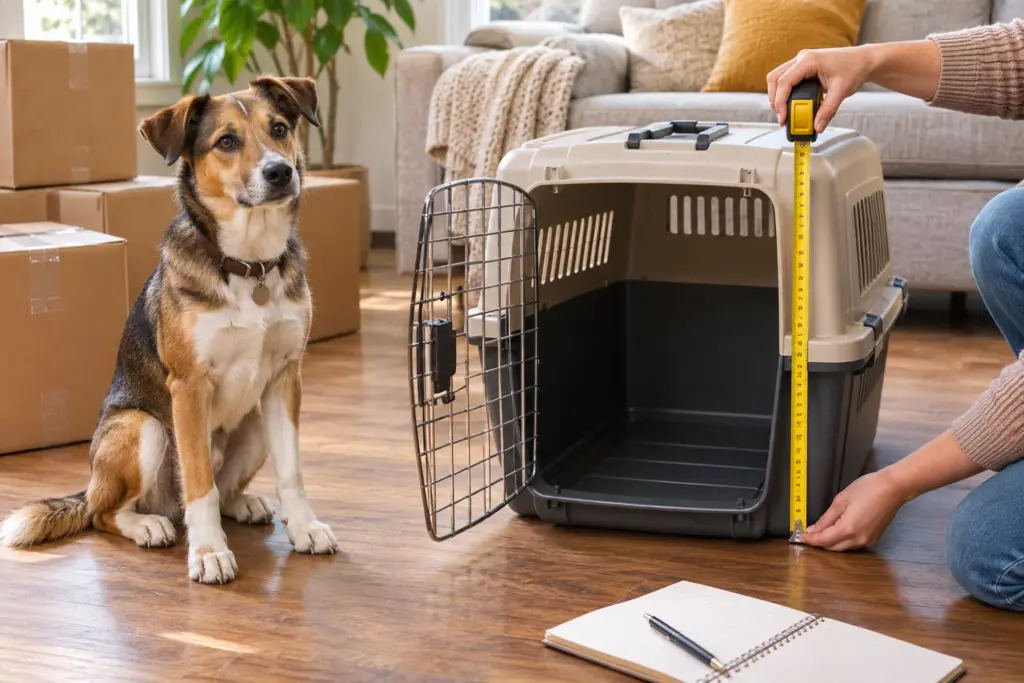
For pets flying as cargo, airlines charge by weight, and for animals that usually means the volumetric weight of the crate rather than the weight of the pet alone. The crate must let your pet stand, turn around and lie down naturally, so a tall or long dog needs a larger crate, and the crate size often has more influence on the airfreight than anything else.
Snub-nosed breeds such as Pugs, French Bulldogs, Persians and British Shorthairs are a special case. Many airlines restrict them or require a crate one size larger for ventilation, and some routes do not accept them at all. Our pet crate size guide shows how to measure your pet so the crate is right the first time.
3. Cargo, VIP or hand-carry
Most pets entering Indonesia fly as cargo, in a temperature and pressure controlled hold, booked under an air waybill. This is the standard route and the one most airlines support for live animals. You can read more about how it works in our guide to cargo pet travel.
In some cases a VIP or hand-carry option is possible, but only where the airline and the route allow it, and usually only for small pets. It involves a person travelling with your pet, so it is a different type of service with a different cost. We confirm per booking whether it is available rather than assuming it.
4. Veterinary work and documents
Before departure your pet needs an ISO compatible microchip, a valid rabies vaccination given after the chip, other routine vaccinations and treatments, and an export health certificate endorsed by your national authority. Depending on the origin country and the current rules, a rabies antibody blood test may also be requested. Indonesia also requires an import permit arranged before your pet travels.
Vet fees vary a lot between countries and clinics, and most of this work is paid directly to your vet. The part that affects the overall cost most is timing: documents that expire or contain a mismatched microchip number have to be redone. Our guide to getting the health certificate approved lists the details that most often cause a redo.
5. Jakarta arrival and quarantine
On arrival at Soekarno-Hatta your pet is inspected by Indonesian Quarantine and completes the required quarantine period before release. The length is set by the authorities based on your pet’s documents and condition, so it is typically confirmed close to the travel date. Requirements can change, and we check the current rules with Barantin (karantinaindonesia.go.id) for your route before anything is booked.
The arrival stage includes airport handling, customs clearance, quarantine facility costs and care during that period. A longer stay means more days of boarding and care. Our guide on how long pet quarantine takes in Indonesia explains what affects the duration.
6. The onward leg to Bali or another island
Release in Jakarta does not automatically mean your pet can continue to Bali. Bali has its own animal movement rules on top of the national import rules, and the domestic flight is documented and booked separately. For owners heading to Bali, this onward stage is a real part of the budget, not an afterthought. The steps are covered in our guide to the Jakarta to Bali flight after quarantine.
7. Door-to-door services and timing
Home pickup in your origin city, boarding before the flight, ground transport after release and delivery to your new home all add to the scope. Some owners want every step covered, others handle the origin side themselves. The season matters too: holiday peaks, heat restrictions on some routes and limited cargo space can narrow the flight options and affect the quote.
What usually increases the cost, and what keeps it down
The most common reasons a move ends up costing more than planned:
- Starting late, so documents have to be rushed or redone when a date slips.
- A crate that is too small and gets refused at check-in, which can mean a new crate and a new booking.
- Microchip numbers that do not match across every document.
- Choosing a route with several transits when a simpler routing was available.
- Assuming Bali is reached directly and only planning the onward leg after arrival in Jakarta.
What helps keep the cost predictable:
- Start 6 to 8 weeks before your intended travel date. Anyone promising a much shorter timeline is skipping steps that matter for entry.
- Measure your pet early and buy the right crate once.
- Keep one folder with every vaccination and vet record, and check the chip number on each page.
- Be flexible by a few days on the travel date so the best routing can be used.
- Decide early which parts of the door-to-door service you need.
If you are weighing up whether to organise the move yourself, our comparison of DIY pet transport and professional services looks at the time and risk involved on each side.
How to get an accurate quote
We prepare each quote for the specific pet and route, so the more detail you share, the closer the quote is to the final cost. Please have these ready:
- Origin city and country, and your destination in Indonesia (Jakarta, Bali or another island).
- Species, breed, age and weight of each pet.
- Your pet’s measurements, or the crate you already own.
- Microchip and rabies vaccination records.
- Your intended travel window.
- Which services you need: home pickup, boarding, delivery to your new home.
Send these through our pet relocation to Indonesia page and we will come back with a quote for your route, including what is covered and what is paid directly to your vet or the authorities.
FAQ
How much does it cost to bring a dog to Bali?
It depends on your origin country, your dog’s size and crate, the airline routing into Jakarta, the quarantine stage and the onward leg to Bali. Because a large dog from Australia and a small dog from Singapore have very different crate and flight costs, we quote each move individually once we know the details listed above.
Can I get a pet transport quote from Australia to Bali?
Yes. Share your pet’s breed, weight, measurements, departure city and travel window, and we will quote the full route: export from Australia, the flight into Jakarta, arrival and quarantine, and the onward leg to Bali.
Is a bigger dog always more expensive to move?
Usually, yes, because airfreight is based on the volumetric weight of the crate. A tall dog in a giant crate costs more to fly than a cat in a small one. Snub-nosed breeds can also need a larger crate than their size suggests.
Does quarantine in Jakarta add to the cost?
Yes. Quarantine is mandatory on arrival, and the facility, care and handling during that period are part of the overall cost. The length is set by the authorities, so we confirm it for your route before travel.
Can my pet fly in the cabin to save money?
For international arrivals into Indonesia, pets generally fly as cargo. A VIP or hand-carry option exists only where the airline and route allow it, and it is a separate service rather than a cheaper one.
Why do you not publish a fixed figure online?
Because a fixed figure would be wrong for most moves. Airfreight, routing, vet requirements and quarantine all change with the route, the pet and the season, so a quote based on your details is the only figure you can plan around.